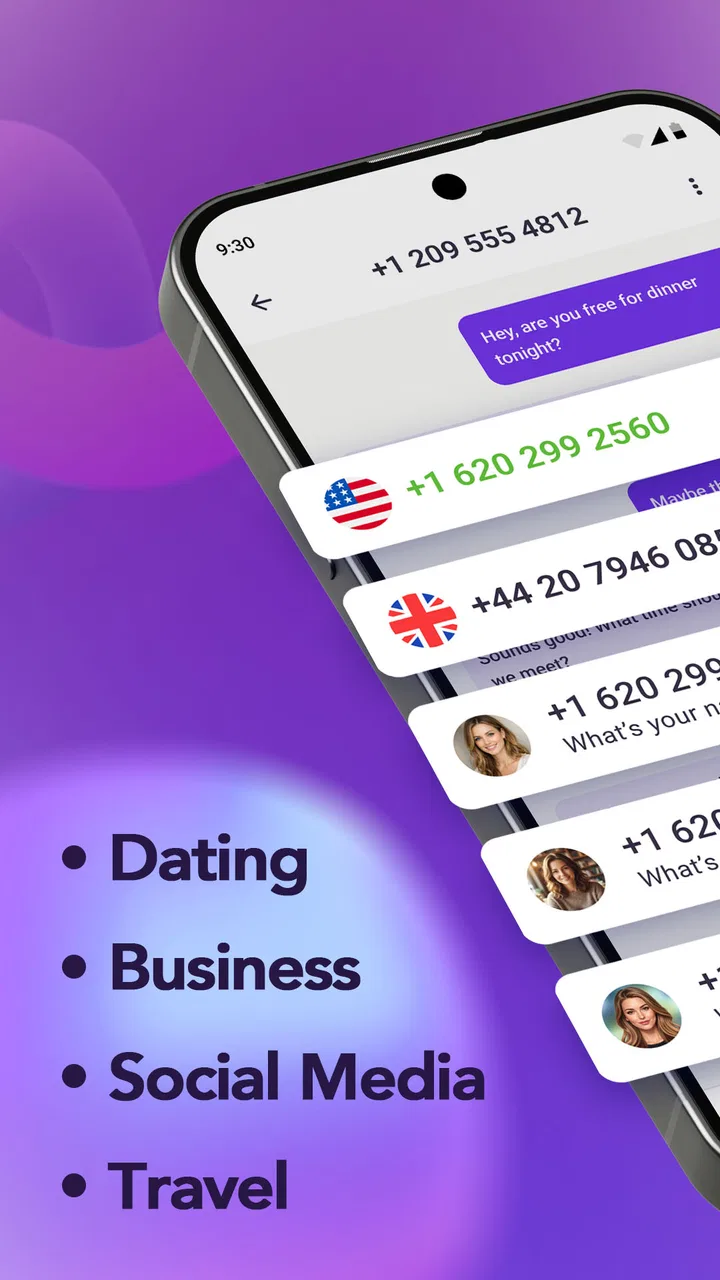
Text Number:Phone Text for Now
- 4.5
- Rating
- 100.00K
- Installs
- Free
- Price

 Analysis by App-foxy
I approached Text Number:Phone Text for Now as a practical communication tool rather than another full-featured social platform. Its central idea is simple: give me a second phone number and a separate line for texting, without asking me to replace the number attached to my everyday phone service. That single capability shapes nearly everything useful about the app.
In my experience, a second number is most valuable when I need a boundary, not when I need another place to collect conversations. A temporary contact for a marketplace exchange, a number for a side project, or a separate line for casual conversations can all be easier to manage when they do not share the same identity as my main number. The app is free to install, aimed at Everyone, and belongs in the communication category. It is made by Text Number Free text App.
The app has attracted an average rating of 4.7 from over 600 ratings, with more than 50 thousand installs. Those figures suggest that the straightforward promise resonates with a useful group of people, although popularity alone does not tell me whether it fits every communication need. I found the strongest case for it in separation: keeping a second texting identity distinct from the number I give to family, work, banks, and important accounts.
You May Also Like

 Blood Strike: 2.5 Anniversary
Blood Strike’s Loadouts Turn Every Drop Into a Tactical Gamble
A close look at Blood Strike’s custom loadouts: how fast access to signature weapons reshapes its battle royale rhythm, rewards preparation, and narrows the gap between fights.

 Pandora - Music & Podcasts
Pandora’s Music Is Easy to Start, but Harder to Recover
Pandora’s strength is its low-effort path from a seed to a station. Its weak spot is how much confidence it asks you to place in connection, setup, and quiet recovery.

 8 Ball Pool
 Is Built on Rivalries, Rematches, and Routine
A close look at the rivalries, rematches, shared routines, and unanswered safety questions that turn a quick pool match into a persistent mobile community.

 Samsung Music
’s Quiet Strength Is Playing What You Already Own
Its reach comes less from spectacle than from dependable access to a personal library. That simplicity is both the app’s strongest retention engine and its ceiling.

 AccuWeather: Weather Radar
AccuWeather Review: A Quick, Clear Forecast for Everyday Decisions
For everyday plans, the best forecast is the one you can understand quickly. AccuWeather makes rain timing, radar, and local conditions easy to act on, with a few trade-offs.

 Hill Climb Racing
Why Hill Climb Racing Still Turns Crashes Into One More Run
A tiny car, a bumpy hill and one more upgrade: Hill Climb Racing keeps resurfacing because its simple chaos makes every near-miss feel personal.
More From Our News Desk
View All News


One extra line, and why that matters
I find the extra line most useful when I decide what belongs there before sharing it. This section looks at how a clear purpose can make the number easier to manage, especially when everyday messages compete for attention, and why a small routine matters more than simply adding another contact channel.
A focused answer to a common communication problem
The verified capability here is the second phone number for texting. That sounds modest, but it changes how I handle situations where giving out my primary number feels unnecessary. Instead of handing over the same contact detail I use everywhere, I can use another line for conversations that may be short-lived, informal, or connected to a particular activity.
That distinction is more useful than simply having another messaging inbox. A separate number can make a conversation easier to classify before I even open it. If I use one line for a local sale, another for a small freelance project, and my regular number for personal contacts, the purpose of an incoming message is clearer. The app therefore works best as a lightweight layer between my private communication and the less predictable parts of daily life.
I would not treat this as a complete replacement for a mobile carrier line. The appeal is convenience and separation, not the promise of becoming a second full-service phone customer. Anyone choosing it should think first about what kind of conversations they want to move away from their main number. If the answer is “occasional texts and a distinct contact identity,” the concept is easy to understand. If the answer is “I need every phone function to behave exactly like my primary line,” expectations should be more cautious.
What the second number changes day to day
The biggest practical benefit is control over disclosure. My main number often ends up attached to delivery accounts, appointment reminders, community groups, and one-off conversations. Once it spreads, reducing that exposure is difficult. A second line lets me make a more deliberate choice at the moment someone asks for contact information.
There is also a psychological benefit. I can look at the second line as a workspace or buffer. That makes it easier to keep casual conversations from interrupting personal ones, even before I decide whether to reply. The separation is especially helpful for people who want to keep a small business, hobby, or occasional selling activity apart from family chats without carrying another physical phone.
One non-obvious use is planning around changing availability. For a short project, event, or temporary arrangement, I can use the second number as the contact point and avoid making my everyday number part of a relationship that may end soon. I still need to manage the conversation responsibly, but the initial boundary is clearer.
How I would set up a useful routine
I would begin by deciding what the second line is for and keeping that purpose narrow. “Everything that is not personal” sounds convenient, but it can quickly create another noisy inbox. A better approach is to choose one role, such as side work, online listings, or community coordination, and use the number consistently for that role.
That workflow produces a useful trade-off. The number becomes easier to recognize and explain, but it may not be suitable for every contact. I would avoid using it as the sole contact method for services where losing access could create serious problems. Important accounts, recovery details, and sensitive personal matters deserve a communication route I know I can maintain reliably.
I would also tell contacts which line they are using. A second number only creates clarity if I remember to identify it when necessary. Otherwise, someone may assume the message is reaching my regular number and become confused when my response style or availability differs. The app provides the separate channel; the organization around it still depends on me.
A realistic everyday example
Imagine I am selling a desk locally. I want interested people to text me, but I do not want to publish my main number in a listing that may remain visible after the desk is gone. Using the second line gives me a dedicated contact point for questions about the item, pickup timing, and price discussions.
In that situation, the benefit is not that the app makes the sale automatically. It is that the conversation has a defined boundary from the beginning. I can check that line when I am available, recognize why a message arrived, and keep the exchange separate from family and work conversations. Once the sale is complete, I can stop using that number for the listing rather than continuing to expose my everyday contact detail.
A similar pattern works for a small creative project. If I am coordinating participants for a local activity, the second number gives me a contact identity that feels more appropriate than my personal line. It also helps me explain to new contacts why their messages should go to one place and personal friends should use another.
Where it sits beside familiar alternatives
The usual alternatives are a carrier-provided second line, a separate prepaid phone, or an ordinary messaging service tied to an existing account. A physical second phone can offer a stronger feeling of separation, but it adds another device to charge, carry, and maintain. A carrier option may feel more integrated, yet it can be excessive when all I need is a distinct texting channel.
Compared with a general messaging service, the phone-number approach is more immediately understandable to people who already communicate by text. I do not need to persuade every contact to join a new social network or learn a different identity system. That is a meaningful advantage for practical conversations, especially when the other person only wants to send a quick message.
The limitation is that familiarity can create assumptions. Some people may expect a second number to behave exactly like a traditional carrier line, while the reason to choose this app is its lighter, more focused role. I would choose a conventional carrier solution when dependable service across a broad range of phone needs matters more than convenience. I would choose a general messaging platform when group features, media sharing, or an established social circle are the main priority.
The friction I noticed in the concept
A second line can solve one organizational problem while creating another: I now have another place to monitor. If I use the number widely, I may miss messages unless I build a habit around checking it. This is not a flaw unique to the app, but it is the most important practical cost of the capability.
There is also a risk of false confidence. A separate number can reduce unwanted exposure, but it should not be treated as a guarantee that every conversation is private, permanent, or appropriate for sensitive information. I would keep personal identifiers and high-stakes discussions on channels I already trust and understand well.
The app includes in-app purchases ranging from $2.99 to $39.99 per item. Since the basic app is free, I would start without paying and first test whether the second-line workflow actually fits my routine. The paid options may make sense for someone who uses the app regularly, but occasional users should consider whether their need is frequent enough to justify spending beyond the free starting point.
Another point worth considering is platform compatibility. The listed minimum operating-system requirement is version 9, so I would check my device before planning around the app. The current version is 1.6.1, which gives me a clear reference when troubleshooting or checking whether my installation is up to date.
Who benefits most from the separate number
I see the strongest fit for people who need a communication buffer without carrying another phone. Online sellers, independent workers, renters dealing with inquiries, volunteers, event organizers, and anyone managing a small side activity can all benefit from a contact line that is not their primary number.
It is also a sensible option for someone who wants to test a new communication arrangement before committing to a more expensive or permanent setup. The free entry point makes that trial easier, while the second-number concept is simple enough to evaluate quickly: either the separation reduces clutter and exposure, or it does not.
People who should skip it are those looking for a complete replacement for their normal mobile service, a sophisticated team communication system, or a platform centered on large group conversations. They may be better served by a carrier plan, a business phone solution, or a messaging service whose main strength is collaboration rather than a distinct texting identity.
Network access and the moments that matter
A texting line is only useful when the conversation can move between the app and the people relying on it. I would plan to use it when I have a dependable connection rather than assume that an incoming message will be available in every situation. That matters most for time-sensitive exchanges, such as arranging a pickup: I would agree on a backup plan with the other person instead of relying on a last-minute message alone.
For a casual inquiry, a delay may be an inconvenience; for a meeting or handoff, it can disrupt the whole plan. My practical habit would be to check the line before leaving home and again when I reach a place with reliable connectivity. This is not a special feature, but a sensible way to avoid treating a second texting identity as an always-reachable emergency channel.
Using it on the move without creating confusion
The app makes the most sense when I can keep its role clear while switching between everyday contexts. If I am commuting, working, or handling errands, I would avoid giving out the number for a conversation that requires immediate, guaranteed contact. For a slower exchange, I can reply when it suits me and make that expectation clear from the start.
A useful small habit is to include the purpose in the first message or introduction: for example, that this is the number for a sale or a project. It helps the other person recognize the line later and gives me a quick reminder of why the thread exists. I would also keep the number out of unrelated conversations; otherwise, the extra channel becomes another general inbox rather than a practical boundary.
What to do when a message does not arrive as expected
If someone says they have texted and I cannot see the conversation, I would first confirm that they used the second number rather than my regular one, then check the connection and reopen the app. I would not assume that silence means the other person has ignored me, or that a message has definitely failed. For anything important, I would ask them to try again or use a contact method we both already know works.
This recovery mindset is particularly useful for marketplace and event conversations. I would avoid making a single text the only source of a pickup address or schedule change. Keeping essential details in a form I can refer back to, and confirming arrangements before setting out, reduces the consequences of a missed or delayed exchange without demanding complicated setup.
Keeping data use intentional
I would use the second line selectively rather than hand it out wherever a form asks for a number. Each additional contact can create messages I need to sort, and the point of this app is to create a useful separation, not to collect every possible conversation in one more place. A narrow role also makes it easier to decide when a contact no longer needs the number.
Before relying on it for a long-running arrangement, I would consider how much the conversation matters and whether I am comfortable depending on this line for it. I would keep essential recovery contacts and sensitive discussions on a channel I already trust. That distinction is especially important for anyone tempted to use a second number as a blanket privacy solution: it can limit how widely a primary number is shared, but it does not make every exchange anonymous or risk-free.
My final take after using the idea in real routines
I like Text Number:Phone Text for Now because it concentrates on one useful problem instead of pretending that every communication need is the same. The second number is valuable when I need a boundary between personal life and temporary or practical conversations. Used with a clear purpose, it can make contact sharing feel more deliberate and reduce the pressure to expose my everyday number.
My recommendation comes with a simple condition: treat it as a focused second line, not as a universal phone replacement. Decide what the number is for, check it consistently, and avoid making it the only route for important accounts or sensitive matters. That approach gets the most from the app while keeping its limitations visible.
For a free communication app with an Everyone age rating and a current version of 1.6.1, it offers a clear starting point for anyone who wants an extra texting identity. I would recommend trying it to people who value separation and convenience. I would not recommend it to someone who already needs a full second mobile service. The real strength is not having another inbox; it is having a practical boundary around who gets my main number.
FAQs for Text Number:Phone Text for Now
01What is Text Number: Phone Text for Now and how does it work?
Text Number: Phone Text for Now is an app that allows users to send and receive text messages using a virtual phone number. This is particularly useful for maintaining privacy or for users who need a temporary phone number for online activities. The app provides a seamless interface for texting, making it easy to communicate without revealing your personal number.
02Is Text Number: Phone Text for Now free to use?
Text Number: Phone Text for Now offers a free tier, which includes basic texting capabilities. However, there might be limitations on the number of texts you can send or receive. To unlock additional features or remove ads, the app may offer in-app purchases or subscriptions for a more comprehensive experience.
03Can I use Text Number: Phone Text for Now for international texting?
Yes, Text Number: Phone Text for Now supports international texting. However, it is important to check if there are any additional charges for sending messages to international numbers, as these can vary based on your subscription plan or the specific regions covered by the app.
04How secure is my information on Text Number: Phone Text for Now?
The app prioritizes user privacy and security. It typically employs encryption to protect your messages. However, it is essential to review the app’s privacy policy and terms of service to understand how your data is handled and to ensure it meets your security expectations.
05Can I choose my virtual phone number in Text Number: Phone Text for Now?
The app often allows users to select a virtual phone number from a list of available numbers. This can include options for different area codes. However, availability might be limited based on demand, so you might not always get your first choice. It's best to check the app for current options.
Pros
- User-friendly interface for quick navigation.
- Supports multiple phone numbers seamlessly.
- High-quality call and text functionality.
- Offers robust privacy features and encryption.
- No additional hardware required.
Cons
- Limited free version features available.
- Occasional ads can be disruptive.
- Requires stable internet connection.
- Not suitable for emergency calls.
- Subscription can be relatively pricey.

Text Number:Phone Text for Now
Gallery